Tul.AI — Scholarship Opportunity Bridge
My first hackathon project, built with Team “HAHAHA” for Can You HackIT: The IBPAP Challenge (Cebu). Tul means bridge in Bisaya: the prototype helps Filipino students find scholarships they qualify for, check requirements and deadlines, and get AI explanations grounded in verified sources. It supports guidance in Bisaya, Tagalog and English.
Overview
Tul.AI is a scholarship discovery prototype for Filipino students. “Tul” means bridge in Bisaya: the product is designed to bridge students to funding opportunities that already exist but can be difficult to find. Students create a profile, receive scholarship matches based on structured eligibility data, check requirements and deadlines, and continue to the provider’s official application page. Eligibility matching is deterministic; the AI explains results from verified source material rather than deciding who qualifies.
My role
Team member on Team “HAHAHA”. Tul.AI was our entry for Can You HackIT: The IBPAP Challenge (Cebu), and this was the first hackathon I attended.
Project details
- Event
- Can You HackIT: The IBPAP Challenge (Cebu)
- Date
- August 17, 2026
- Venue
- Cebu Institute of Technology – University (CIT-U)
- Team
- Team “HAHAHA”
- Milestone
- My first hackathon
- Recognition
- Certificate of Participation
Project media
Product demo and marketing video
3:13 · 1080p
A 3-minute, 13-second walkthrough of the student profile, ranked scholarship matches, verified-source AI assistance, saved opportunities and responsive experience.
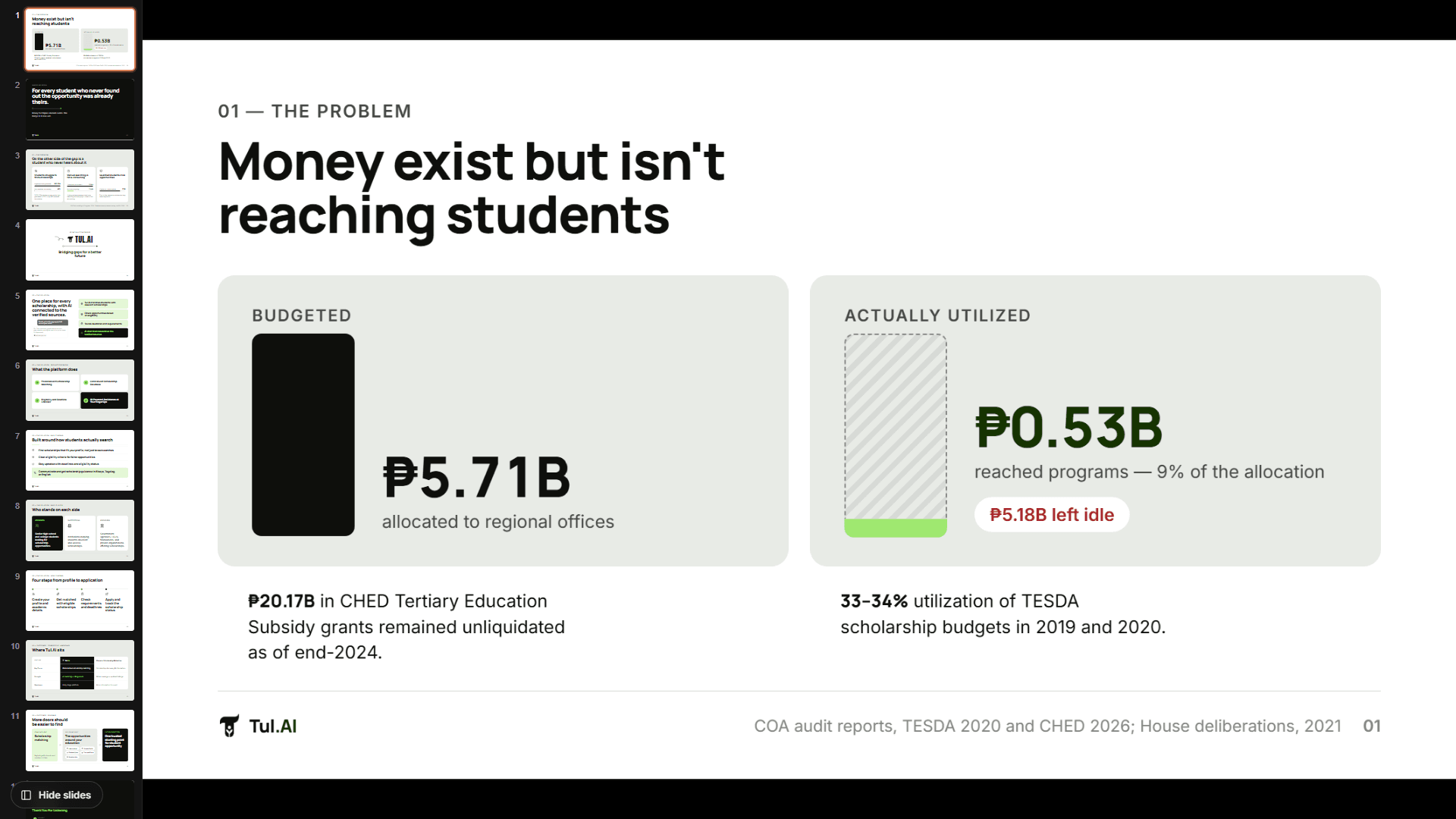
Tul.AI pitch deck
12 slides · Interactive HTML
The 12-slide hackathon deck covering the funding and discovery gap, the product workflow, target users, competitive position and roadmap.
Open pitch deck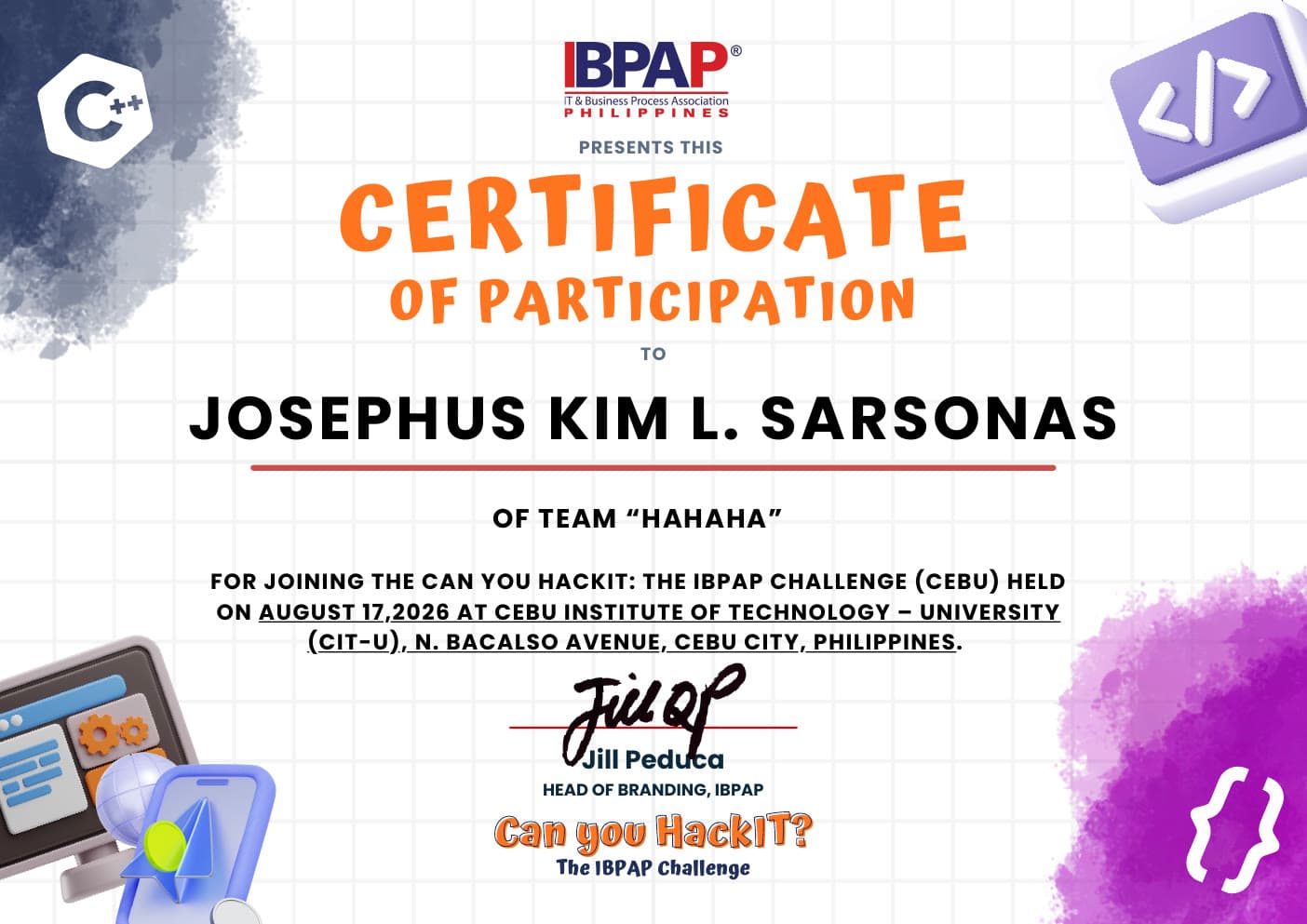
Can You HackIT certificate
Certificate of Participation · PDF
Certificate of Participation issued to Josephus Kim L. Sarsonas of Team “HAHAHA” by IBPAP for the Cebu challenge.
Open certificateLessons learned
- Building under hackathon constraints
My first hackathon forced the team to turn a broad student-access problem into a focused prototype, a clear product story and a working demonstration in one event.
- Keeping eligibility explainable
Structured rules decide whether a scholarship matches. AI is used to explain the published information and cite the verified source, not to make the eligibility decision.
- Designing for local context
The experience supports guidance in Bisaya, Tagalog and English, and begins with students and scholarship providers in Cebu.
- Pitching the problem before the product
The deck starts with the funding and discovery gap, then introduces Tul.AI as the bridge. That sequence made the product easier to understand than opening with a feature list.